


Organization Governance
Discovery
Ideation
Design
Prototype
A central hub for administrators to manage workspaces, user lifecycle, authentication and authorization within their organization.
Project
Overview
Cloud platforms like HPE GreenLake must be flexible enough to handle different customer setups. The deployment of HPE GreenLake should be able to adapt to customer needs from a single setup at the edge, a few workspaces joined together to share services, or many separate workspaces to keep data isolated and secure. This scaling ability means that no matter how much a business grows, its control, management, and billing always stay together in a centralized place.
The current HPE GreenLake Cloud platform lacks a workspace hierarchy framework. This "parent-child" structure is critical for complex enterprise customers to manage multi-layered environments, as well as for existing customers looking to scale their cloud deployments. Without this framework, organizations are forced into a flat ecosystem where admins experience severe administrative bottlenecks and fragmented user access controls that prevents large corporations from operating efficiently.
As the Lead UX Designer, I partnered with a multidisciplinary team - including a UX architect, technical architects, developers, researchers and product managers - to discover user needs and to drive the design vision. I spearheaded ideation in close collaboration with the UX Architect while ensuring consistent alignment between product and engineering stakeholders.
Timeline
Q1 2025 - Q3 2025
Media mentions
Discovery & Empathize
Reviewing the PRD (Product requirement document) with internal stakeholders
I kicked off the project by reviewing and discussing the PRD. The main topic of discussion was the assumption there is a critical architectural gap in the current implementation on HPE GreenLake Cloud platform in that it lacks a hierarchy concept for workspaces.
"Organizations / Organization governance"
Is a term that is widely used in the cloud and SaaS industry to describe a set of features that enable customers to manage their users, resources, and policies across multiple services and applications.
Competitor research insights
Public cloud and SaaS providers leverage organizational governance models to streamline several critical operational areas:
-
Security
-
Compliance
-
Identity Management
-
Budgeting and invoicing
-
Ease of managing differing teams, departments, environments, and projects.


What the competition is prioritizing
Identity and Access Management (IAM) has become a critical competitve differentiator in the evaluation of large contracts for cloud services. As organizations increasingky prioritize security and compliance, robust IAM soutions are essential for protecting sensitive data and ensuring secure access. Major cloud providers like Google Cloud Platform (GCP), Microsoft Azure, and Amazon Web Services (AWS) recognize this need and invest heavily in their IAM capabilities to meet stringent customer requirements and stay ahead of the competition.
What our users had to say
On a separate project, I collaborated with UX research to conduct a few user interviews around IAM in general. Here were some of the key findings from those interviews.

Key findings
"Right now, I have no global view of who has access to what across the entire platform. It's a compliance nightmare."
- Interview participant
-
Inefficient Lifecycle Management: Managing users across numerous workspaces requires logging into each environment separately to perform manual onboarding and offboarding.
-
Administrators need more granular control over permissions and the ability to create user groups in a single interface to streamline their workflow.
-
Administrative Burnout: Admins are forced to manually repeat identical identity, access, and compliance setups across many separate workspaces.
Define & Strategy
Feature matrix
Using a feature prioritization matrix, I aligned functional requirements with business goals to prioritize which features to start with for an minimal viable product that's scalable towards a solid enterprise-ready governance system.

Finding alignment
To establish a foundation for the HPE GreenLake organizational governance framework, I participated in a data-driven prioritization process with stakeholders for the initial product release. I used PRD analysis, feature matrix map, competitive benchmarking, and user feedback to show a strong demand for an more enhanced identity and access controls. I presented these insights to stakeholders, gaining consensus to prioritize identity management in the first release to ensure immediate compliance and scalability.
Defining the how might we statements
How might we scale our existing IAM infrastructure to support complex, multi-layered workspace governance?
How might we create a "single pane of glass" that allows org. admins to manage the entire user lifecycle across multiple workspaces without increasing cognitive load?
How might we design a flexible permissioning system that gives admins granular control over user access at both the workspace level and the specific service level, without making the interface feel overwhelming?
How might we streamline domain verification and SSO federation so that admins can securely lock down organizational identity with total confidence?
Ideation
Mapping the Organization hierarchy structure
To help the developers understand the hierarchy structure of an organization I designed this concept diagram.
At the top organization level there's a dedicated identity directory that is shared across workspaces managed by an organization.
The middle tier is:
-
Management groups which are defined in an "organization".
-
Cross workspace governance is done with Management Groups.
-
Not prioritized for MVP.
-
The bottom tier is:
-
The workspaced where end users consume / operate resources.

Initial user journey map
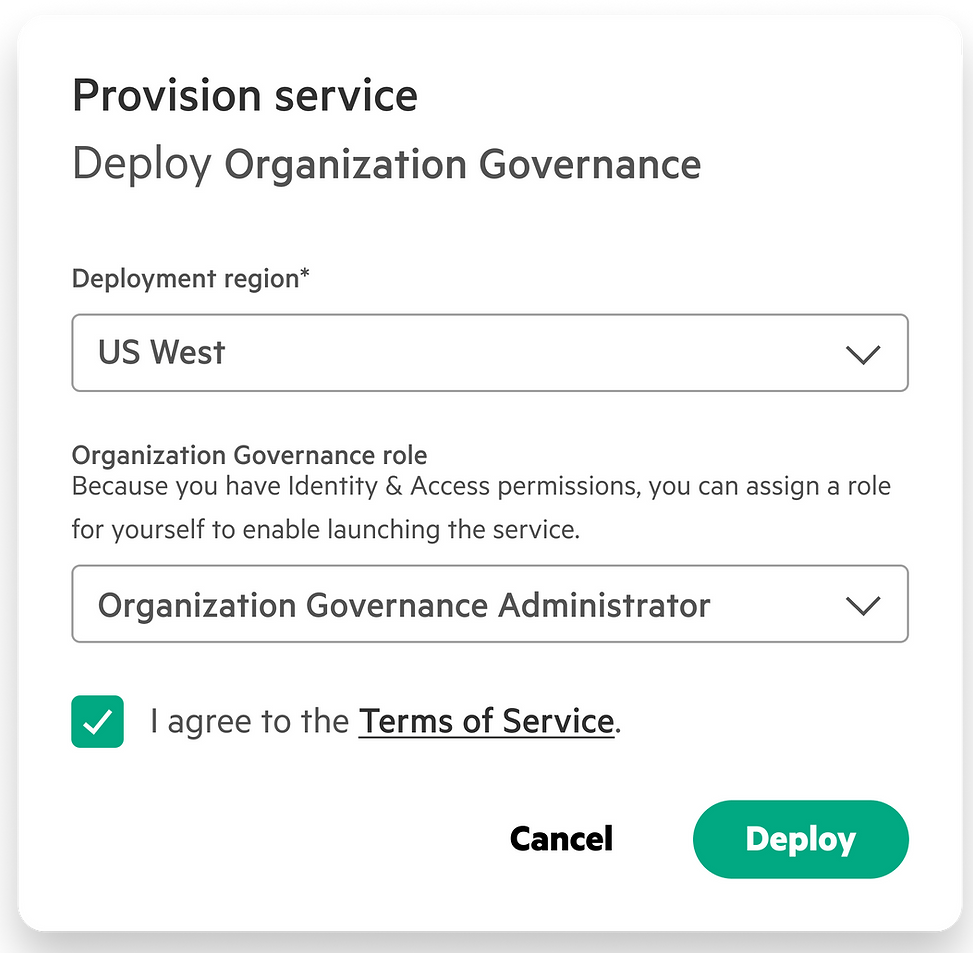
I collaborated with the UX Architect to map user discovery pathways for the Organizational Governance feature. We decided to pitch and validate an 'As-a-Service' model, allowing administrators to discover and provision governance capabilities directly from the service catalog.

Since the user flow relies entirely on an established UI framework, creating low-fidelity mockups was unnecessary. Instead, I immediately adapted the existing screens to save time and maintain design consistency. Doing this also allowed the product team to promptly begin user testing to gather early feedback.
Service / Catalog page

Final user journey map
Following multiple iterations and collaborative reviews with design peers and internal stakeholders, we aligned on this optimal user journey flow.
This user journey maps the flow of enabling organization governance features through the 'Manage workspace' page.

Updated site map
Highlighting the new organization features when enabled in yellow.
.png)
Organization Governance page (Pre-provision state)
.png)
Organization Governance page (Post-provision state)

Home page (w/ Organization Governance)

Organization Governance page

Initial design feedback
The feedback received from users and internal stakeholders were mixed on this initial user flow of enabling organization governance capabilities. Here were the specific comments users and internal stakeholders made:
-
Treating Organization Governance as-a-service will have involve a separate team (service team) and their API's. - Internal stakeholder
-
Hierarchy structure is not clear if Organization Governance is a provisioned service. - Internal stakeholder
-
When provisioning Organization Governance is choosing a deployment region necessary? - User
-
Organization Governance as-a-service is not intuitive and a little bit confusing - User and Internal stakeholders
-
Organization Governance service page information needs to be reviewed / discussed further. - Internal stakeholders
-
Explore other pathways to enable Organization Governance capabilities. - Internal stakeholders
Self-service workflow to enabling organization governance features
This the final user flow design after multiple back and forth design reviews with internal teams.

Although I was able to adapt the Org feature resources on existing UI framework it required deep, cross-functional collaboration with system architects and engineers to reconcile data schemas, resolve technical constraints, and deliver a seamless end-to-end design solution.
Organization users page

User groups page

SSO connection page

Member workspaces page


Learnings & retrospective
Beta testing insights
-
Combine workspace users page with organization users.
-
Design the workflow for OIDC SAML protocol.
-
Design the workflows for external SCIM integrations.
-
Merge organization goveranance resources to the manage workspace page. A separate page for organization goveranance is not needed.
Constraints
-
Legacy Identity and Access Management architecture - compatibility & migration constraints
-
Product team disruptions
-
Evolving architecture thesis
-
Scope creep
-
API deficiencies
-
Siloed domain knowledge
Explore more projects


Enhanced Sign-in Experience
Unified fragmented local and federated sign-in flows into a single, seamless authentication experience.
Coming soon...
.jpg)

Item Title Two
Use this space to promote the business, its products or its services. Help people become familiar with the business and its offerings, creating a sense of connection and trust.
Unified fragmented local and federated sign-in flows into a single, seamless authentication experience.

Item Title Three
Use this space to promote the business, its products or its services. Help people become familiar with the business and its offerings, creating a sense of connection and trust.
Unified fragmented local and federated sign-in flows into a single, seamless authentication experience.